
Permits & Rules
Do You Need a Permit for a Dumpster in Scranton, PA?
Scranton's older neighborhoods often leave no off-street option, which pushes containers into the curb lane. Here is when you need a city right-of-way permit, when PennDOT is involved, and how to stay legal.
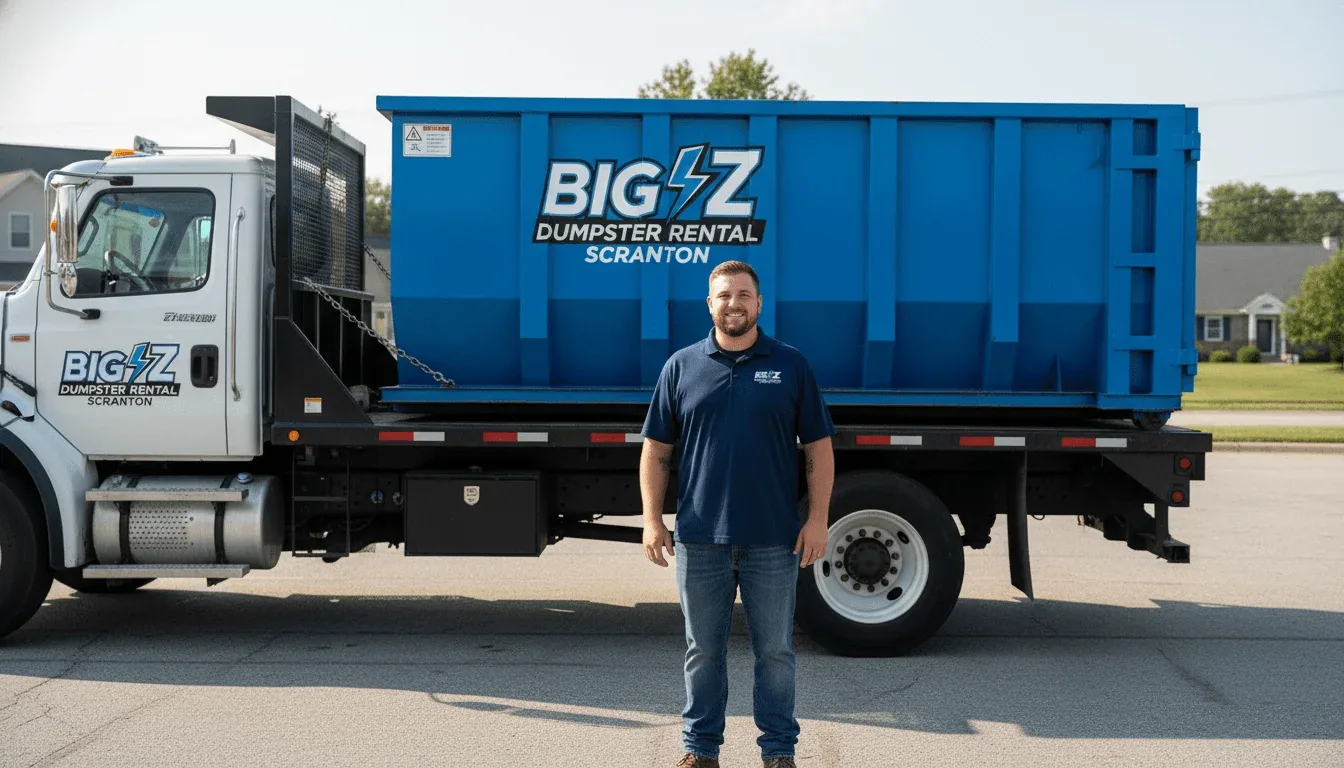
I have been setting roll-off containers in this city since 2011, and the single question that costs people the most time is the one they ask last: do I need a permit to put this thing where I want it? In a lot of markets the answer is a quick no. In Scranton it depends entirely on where the wheels land, and a big share of our neighborhoods simply do not have anywhere to put a container except the street.
Walk through the Hill Section, South Side, West Side, Green Ridge, or the blocks around Providence Road and you will see the problem immediately. Row homes and double blocks built between 1890 and 1930, no garage, no off-street parking, a three-foot concrete walk between the porch and the curb. That housing stock was built for streetcars, not for a 22-foot roll-off truck. So the container goes in the curb lane, and the moment it does, you are occupying the public right-of-way and the rules change.
The Core Rule: Private Property vs. Public Right-of-Way
Here is the principle that covers about 90% of the jobs we do, and it is not complicated.
- On your own driveway, parking pad, side yard, or private lot: generally no municipal placement permit is required. It is your property. You still have to think about weight, clearance and surface damage, but the city is not involved in where you park a container on your own concrete.
- In the public right-of-way — the travel lane, curb lane, on-street parking space, sidewalk, tree lawn, or a city-maintained alley: you typically need a street occupancy or right-of-way permit from the City of Scranton before the container is set. That right-of-way usually extends past the curb line to include the sidewalk, so parking half-on-the-walk is not a loophole.
- On a state-maintained route: some roads that look like ordinary city streets are actually PennDOT routes. Occupying one of those can involve a PennDOT highway occupancy permit in addition to, or instead of, the municipal approval. This catches people out on the busier corridors more than anywhere else.
If you are doing a straightforward garage or basement clean-out at a single-family home with a driveway, this whole article is background reading — book your residential dumpster rental and we will set it on the driveway. If your house fronts directly onto the sidewalk with no drive, keep reading.
Who Applies, and How Far Ahead
In most Pennsylvania municipalities the permit is pulled by either the property owner or the contractor performing the work, and the container company's insurance is referenced on the application. We have been licensed and insured in Lackawanna County since day one and can provide a certificate of insurance for your paperwork — but the applicant is normally you or your general contractor, because the permit attaches to the property and the work, not to the truck.
On lead time, plan on several business days. Some offices turn a simple residential street occupancy around quickly; others route it through engineering or the police department for traffic review, especially on a bus route or a one-way. Do not assume same-day. Our delivery can be same-day; a right-of-way permit generally cannot. Call the City of Scranton and confirm current requirements, timing and fees directly — those change, and I am not going to quote you a number that might be wrong. Start at the City of Scranton website and ask for the office that handles licensing, inspections and permits.
What the Application Typically Asks For
- A simple site sketch — the property, the street, where the container will sit, distance to the nearest hydrant, crosswalk and intersection.
- Container size and footprint. A 10 yard container takes roughly one parking space; a 30 will take two, plus room for the truck to tip.
- Start and end dates. Permits are issued for a defined duration and extensions usually require a request before expiry, not after.
- Traffic control — reflective cones or delineators, reflectors or reflective tape on the container, and in some cases signage or temporary no-parking notices posted in advance.
- Proof of insurance from the hauler and sometimes the contractor.
| Placement | Who approves | Typical lead time | What is usually required |
|---|---|---|---|
| Private driveway or lot | Nobody — owner's call | Same day possible | Owner permission, clearance check, surface protection |
| City street, curb lane, sidewalk or alley | City of Scranton | Several business days | Application, site sketch, dates, insurance, cones and reflectors |
| State-maintained route | PennDOT (often with municipal sign-off) | Longer — plan well ahead | Occupancy permit, traffic control plan, insurance |
| Commercial lot or shopping plaza | Property owner / management | Varies by landlord | Written landlord approval, fire lane and ADA clearance |
| Borough or township street | That municipality's own office | Varies widely | Their own form, their own rules |
Scranton-Specific Realities Nobody Warns You About
Narrow one-ways. Half the residential grid is one-way and barely wide enough for a parked car plus a passing vehicle. Drop a container in the curb lane and you may have effectively closed the street. Reviewers know this, which is why traffic control questions come up on streets that look sleepy at 10 a.m.
Permit parking districts. Several neighborhoods near the University of Scranton and Marywood run residential permit parking. Occupying spaces in those districts is exactly the situation the city wants notified in advance so neighbors are not ticketed or towed out of spaces they pay for.
The back alleys. Behind the row homes and double blocks there is usually a service alley, and it is often the best answer — no traffic lane lost, easy hoist. But those alleys are frequently city-maintained right-of-way too, and they are narrow. If a neighbor's garage or only vehicle access comes off that alley, a container that blocks them is a complaint waiting to happen no matter what your paperwork says.
Grade. The Hill Section and East Mountain have pitches that make a loaded 30-yard container genuinely dangerous to set. We chock and position for grade, and sometimes the honest answer is a smaller box set crossways rather than a big one nosed downhill. Our size guide walks through that trade-off.
Winter. Scranton designates snow emergency routes, and when an emergency is declared those lanes must clear. A container sitting on one is not a gray area. If your project runs November through March, ask whether your street is on a route before you sign anything.
Every Borough Runs Its Own Show
This is the part people get wrong constantly. Scranton's rules stop at the city line. Dunmore, Taylor, Moosic, Old Forge, Dickson City, Olyphant, Archbald, Carbondale and Clarks Summit each have their own municipal office, their own form, their own review process and their own timeline. A permit from one is worth nothing in the next. We deliver across all of these communities, and when a customer says "I already have the permit," my first question is which borough issued it.
If you are a landlord, condo owner or in an HOA, add one more layer: written approval from the association or property manager, plus whatever the municipality requires. Fire lanes, accessible parking and shared drives are where those approvals actually matter.
Student Turnover Season
Late July through late August, the blocks around both campuses turn over at once. Everybody wants a container the same week, on the same narrow streets, and the permit offices see a wave of applications at the same time. If you manage student rentals, book your containers and start your paperwork in June. Waiting until move-out week means competing with every other landlord in the neighborhood for both a box and an approval. Our commercial and property management accounts get scheduled ahead for exactly this reason.
Building Permits Are a Separate Thing
A common mix-up: the permit for the work and the permit for the container are two different animals. A roof tear-off, an interior gut, a deck removal or a structural demolition may require a building or demolition permit under the state's Uniform Construction Code, administered locally. That permit does not authorize you to occupy the street, and a street occupancy permit does not authorize you to swing a hammer. If you are handling demolition debris or a roofing tear-off, confirm both. Disposal rules for certain materials fall under the Pennsylvania DEP, and county recycling and household hazardous waste programs run through Lackawanna County.
Placement Rules That Keep You Legal Anywhere
- Never block a sidewalk so pedestrians must step into traffic. Accessibility is not negotiable.
- Keep clear of fire hydrants, standpipes and fire lanes.
- Do not block mailboxes or the carrier's access — USPS will suspend delivery.
- Stay off storm drains and inlets. Debris and runoff into an inlet is a real violation.
- Never block a neighbor's only vehicle access, and never a driveway apron that is not yours.
- Watch overhead clearance. Older Scranton streets carry low utility drops, cable runs and mature tree canopy. A roll-off hoist needs serious vertical room — considerably more than the container's own height. We look up before we back in; you should too.
- Mark it overnight. Reflective tape or reflectors on the street-facing corners, cones at both ends. On an unlit one-way this is what stands between you and a 2 a.m. claim.
- Protect the surface if it is on your drive. Boards under the rails, every time — see our notes on driveway protection.
What Happens If You Skip It
Best case, a code officer knocks and gives you a day to fix it. Realistically you are looking at a citation, an order to remove the container immediately — which means paying for a haul and a re-set — and if it is tied to unpermitted work, a stop-work order that idles your crew. The one that actually hurts is liability. If somebody clips an unmarked, unpermitted container on a dark street, you are the defendant, and your insurer is going to be very interested in the fact that the placement was never authorized. For state routes, the permitting framework sits with PennDOT, and enforcement there is not casual.
One Phone Call Saves You a Week
Fourteen years in and this is still the honest advice: before you schedule anything, spend ten minutes on the phone. One call to the city or borough office to ask "do I need a right-of-way permit at this address, and how long does it take?" One call to us to talk through where the box can physically go. That is it. Nearly every permitting disaster I have watched unfold started with somebody assuming, and none of them started with somebody asking.
Big Z Dumpster Rental has been placing containers on Scranton's tight streets since 2011 — flat-rate pricing, licensed and insured, same-day delivery when the placement allows it. We know which streets take a 30, which need a smaller box and a second haul, and which need paperwork first. Call (570) 774-4910 or reach out here and we will tell you straight what your address needs before you spend a dollar.
Questions this guide did not answer? Call (570) 774-4910. We would rather spend two minutes on the phone than have you order the wrong container.